Learning Outcomes
On successful completion of this programme a learner will be able to:
-
Explain and apply automation strategies and methodologies, including batch, continuous, and discrete manufacturing systems.
-
Compare and evaluate automation approaches and their impact on productivity, efficiency, and safety in industrial environments.
-
Identify and describe applications of automation and robotics across sectors such as manufacturing, logistics, and utilities.
-
Diagnose, resolve, and document common issues in robotic systems using systematic troubleshooting techniques.
-
Apply industry standards and conduct risk assessments while completing and validating simple robotic control projects or simulations.
Course Content
1. Automation Strategies and Industry 4.0 Context
Learners examine the role of automation and robotics within modern industrial environments and explore the characteristics of discrete, batch, and continuous manufacturing systems. Content includes the selection of automation strategies based on operational requirements, productivity, flexibility, quality, safety, and cost considerations. Learners evaluate how automation technologies are applied across manufacturing, logistics, utilities, and other industrial sectors. The module also introduces Industry 4.0 concepts, connected manufacturing systems, and the increasing use of data-driven automation within industrial operations.
2. Robotic Interfaces and System Operation
Learners develop practical understanding of industrial robotic systems, including robot controllers, teach pendants, end-of-arm tooling, sensors, actuators, and peripheral equipment. Content includes robotic safety principles, manual and automatic operating modes, emergency stop systems, and the establishment of safe robotic work areas. Learners perform robot jogging, coordinate system management, robotic calibration, and end-of-arm tooling calibration. Activities also include configuring digital inputs and outputs, establishing communications between robots, controllers, PLCs, and peripheral devices, and understanding how robotic systems interact within integrated automation environments.
3. Integrated Automation and Troubleshooting Techniques
Learners explore the integration of robotic systems within wider automation architectures. Content includes robotic interfacing, I/O mapping, communication with PLC-controlled systems, conveyor systems, vision systems, and automated packaging or assembly stations. Learners create and modify robotic programs using teach pendants, teach robot positions and movement paths, configure operational parameters such as speeds and coordinates, and implement system instructions required for automated tasks including pick-and-place operations. Structured troubleshooting activities develop skills in diagnosing programming faults, configuration issues, communication failures, and hardware-related system problems, with emphasis on systematic fault-finding and corrective action methodologies.
4. Risk Assessment and Industry Standards
Learners develop knowledge of industry standards, safety requirements, and risk management practices applicable to robotic and automated systems. Content includes hazard identification, risk evaluation, implementation of control measures, validation of safety functions, and verification of safe operating procedures. Learners conduct basic risk assessments for robotic applications, evaluate potential operational hazards, and determine whether robotic solutions meet required safety and performance criteria. The relationship between safety, productivity, and system performance is examined within realistic industrial scenarios.
5. Applied Robotic Control Tasks and Simulations
Learners apply acquired knowledge and skills through practical robotic control activities and simulation-based exercises. Tasks include creating and modifying robotic programs, teaching robot positions, configuring tooling and I/O, integrating robotic devices with automation systems, and validating operational performance against defined requirements. Activities may involve packaging stations, assembly stations, conveyor-based systems, and vision-guided applications. Learners test and optimise robotic system operation, verify achievement of production objectives, and document technical solutions using appropriate engineering terminology and industry practices.
Who Should Attend?
This programme is designed for personnel wishing to advance their careers in Industrial Automation. It is ideal for:
- Engineers & Technicians: Including Manufacturing, Automation, and Maintenance roles looking to improve production efficiency, integrate production lines, and manage predictive maintenance.
- Managers & Team Leaders: Seeking to understand automation tools to improve project workflows, minimize downtime, and increase productivity.
- Technical Personnel: Anyone wishing to gain a good practical knowledge of automation in real-world scenarios.
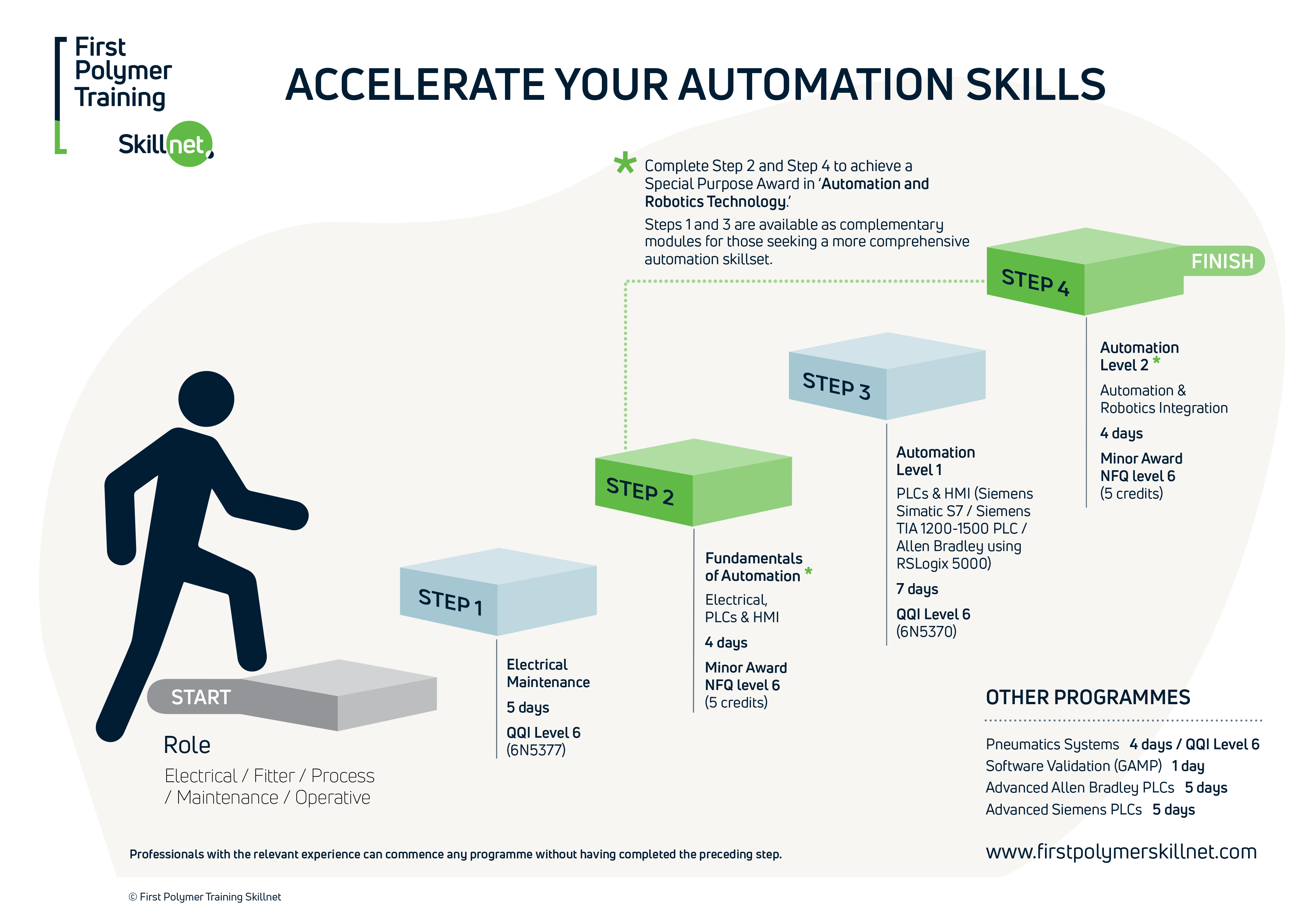
Learners progressing to this Automation and Robotics Integration programme are expected to have completed the Fundamentals of Automation programme or demonstrate equivalent prior learning through RPL.
In addition minimum requirements for this programme:
Intending learners are expected to possess foundational knowledge and experience relevant to manufacturing automation and process control environments. This may include prior exposure to electrical, mechanical, or automated production systems through employment, apprenticeship, or previous training.
At entry, learners should typically:
- possess a basic understanding of manufacturing or automation processes and terminology.
- be able to follow technical instructions and interpret simple process or control diagrams.
- be able to operate within established health and safety procedures in a workshop or industrial setting.
Evidence of discipline-specific readiness may include relevant NFQ awards, apprenticeship training, employer confirmation of role responsibilities, prior technical training certificates, or documented workplace experience.
Learners are required to declare their compliance with the minimum programme access requirements.
Where formal certification is not available, the Recognition of Prior Learning (RPL) for Access procedure may be used. Evidence may include a CV, employer attestation, training records, or other documentation demonstrating practical familiarity with manufacturing or automation environments.
For minimum general entry requirements for all of our programmes including this programme see here
Check out our training facilities here
PLEASE NOTE THIS COURSE IS NOT CURRENTLY ACCREDITED BUT CURRENTLY UNDERGOING A QQI VALIDATION SUBMISSION PROCESS