
Learning Outcomes
After successful completion of this course, trainees will be able to:
- Describe how to achieve isolation and switching for mechanical maintenance and electrical isolation
- Describe the interrelationship between cable sixes, current carrying capacities, fuses, circuit breakers and installation conditions
- Detail the means of protecting against direct contact to include basic insulation, barriers/enclosures, and extra low voltage
- Detail the means of protecting against indirect contact too include double insulation, automatic disconnection by earthing, residual current device(RCD) and isolating reduced low voltage transformers
- Describe D.C and A.C single phase and three phase, their relative merits and applications
- Describe the operation of three phase induction motors, their control protection, connection and testing
- Interpret wiring, circuit and schematic diagrams
- Predict voltages at given points in a circuit and measure these using a multi-meter
- Test a three phase induction motor
- Construct control circuits using typical components to include functional control switches, emergency control switches , normally open switches, normally closed switches, auxiliary contact, contactors and thermal overloads
- Construct a direct on line starter (DOL) and reverse control circuits.
This course focuses on practical skills and theory for electrical troubleshooting. Trainees learn to use machine drawings and multimeters to safely trace the cause of machine stoppages and determine if they can perform a simple fix or need to consult an expert. Key outcomes include diagnosing industrial faults, carrying out minor repairs/replacements safely, identifying potential electrical hazards, and knowing when it is appropriate to call a qualified electrician.
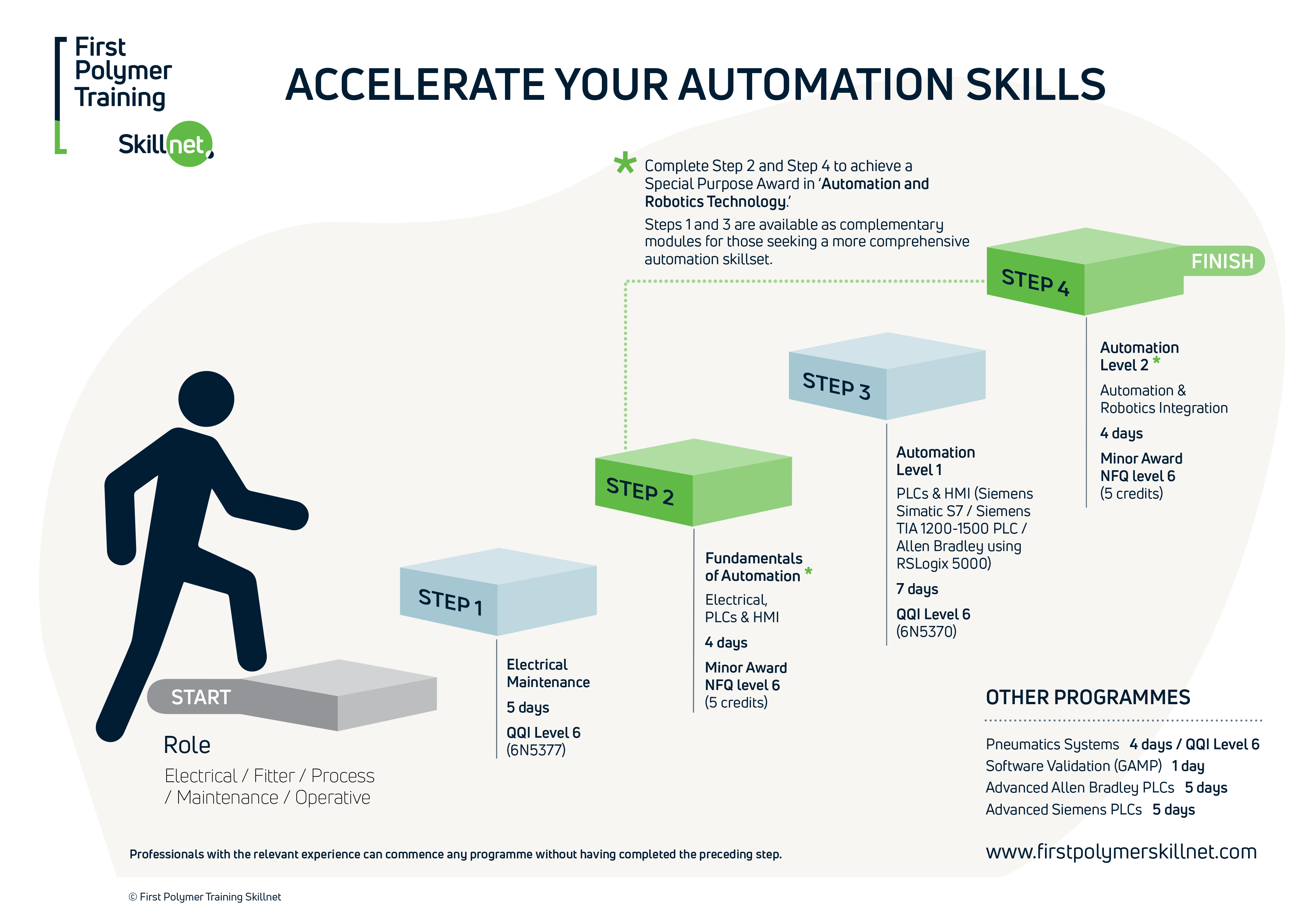
See our full automation pathway below. This course is Step 1 on this pathway.
Check out our training facilities here
Course Content
- Safety
- Lock Out Tag Out
- Electrical Charge
- OHMS Law
- Types of Circuit Supply
- Motors
- Insulation
- Cable Structure
- Types of Conductors
- Cable Specification
- Why use a transformer