
Learning Outcomes
On successful completion of this programme a learner will be able to:
-
Explain and apply fundamental automation concepts, including the principles, components, and architectures of automated systems.
-
Describe, configure, and demonstrate the use of PLC and SCADA (Supervisory Control and Data Acquisition) systems for industrial process control and monitoring.
-
Interpret, develop, and test PLC programmes to meet a defined automation brief.
-
Configure, verify, and fault-find safety features used in automation systems, including safety relays and light curtains.
-
Test and validate basic automation system operation through practical exercises and simulations.
Who Is This Course For
This hands-on programme is designed as an introduction for any personnel that wish to advance their careers in to the world of Industrial Automation. It is suitable for Machine Operators/Process Technicians/Engineers/Production Shift Supervisors and any technical personnel who wish to gain a good practical knowledge of the area.
Course Content
1. Introduction to Automation Systems and Terminology
Learners are introduced to the purpose and application of automation within modern manufacturing and industrial environments. Content includes automation terminology, levels of automation, process control concepts, and the role of automated systems in improving productivity, quality, and safety. Learners examine the relationship between inputs, processing functions, and outputs within automated systems and develop an understanding of how automation solutions are specified and implemented in industrial settings.
2. Automation Components and System Architectures
Learners develop knowledge of the key hardware and software elements that comprise automated systems. Topics include sensors, actuators, motors, relays, controllers, Human Machine Interfaces (HMIs), communication networks, and safety devices. Learners interpret schematic electrical drawings, power distribution circuits, and control system diagrams to identify component functions and understand system operation. Practical activities focus on recognising component interactions within typical automation architectures and manufacturing processes.
3. PLC Principles and Introductory PLC Programming
Learners are introduced to the principles of Programmable Logic Controllers (PLCs) and Supervisory Control and Data Acquisition (SCADA)/HMI systems used for industrial process control and monitoring. Content includes PLC hardware configuration, digital inputs and outputs, logic functions, timers, counters, and introductory program development using PLC controllers. Learners create, modify, test, and validate PLC programs to achieve defined operational requirements, including motor control, sensor monitoring, system status indication, and basic process sequencing. Learners also configure introductory HMI functions, including static and dynamic displays and fault indication screens.
4. Safety Systems and Risk Awareness
Learners develop an understanding of safety principles applicable to automated systems and industrial machinery. Content includes machine safety concepts, risk awareness, emergency stop circuits, machine interlocks, safety relays, safety monitoring relays, and light curtains. Learners examine the purpose and operation of safety devices and develop practical skills in configuring, verifying, and testing safety functions. Activities require learners to demonstrate safe system operation and appropriate responses to fault and emergency conditions.
5. Testing, Validation, and Structured Troubleshooting
Learners develop systematic approaches to testing, validation, and fault finding within automation systems. Content includes verification of PLC logic, validation of input and output operation, monitoring of system behaviour against specified requirements, and identification of common automation faults. Learners apply structured troubleshooting techniques to diagnose and resolve faults associated with PLC programs, HMI interfaces, communication networks, and safety systems. Practical activities require learners to test and validate system performance, confirm correct operation, and communicate technical findings using appropriate engineering terminology.
Minimum Entry Requirements
Intending learners are expected to possess foundational knowledge and experience relevant to manufacturing automation and process control environments. This may include prior exposure to electrical, mechanical, or automated production systems through employment, apprenticeship, or previous training.
At entry, learners should typically:
-
possess a basic understanding of manufacturing or automation processes and terminology.
-
be able to follow technical instructions and interpret simple process or control diagrams.
-
be able to operate within established health and safety procedures in a workshop or industrial setting.
For minimum general entry requirements for all of our programmes including this programme see here
Check out our training facilities here
PLEASE NOTE THIS COURSE IS NOT CURRENTLY ACCREDITED BUT CURRENTLY UNDERGOING A QQI VALIDATION SUBMISSION PROCESS
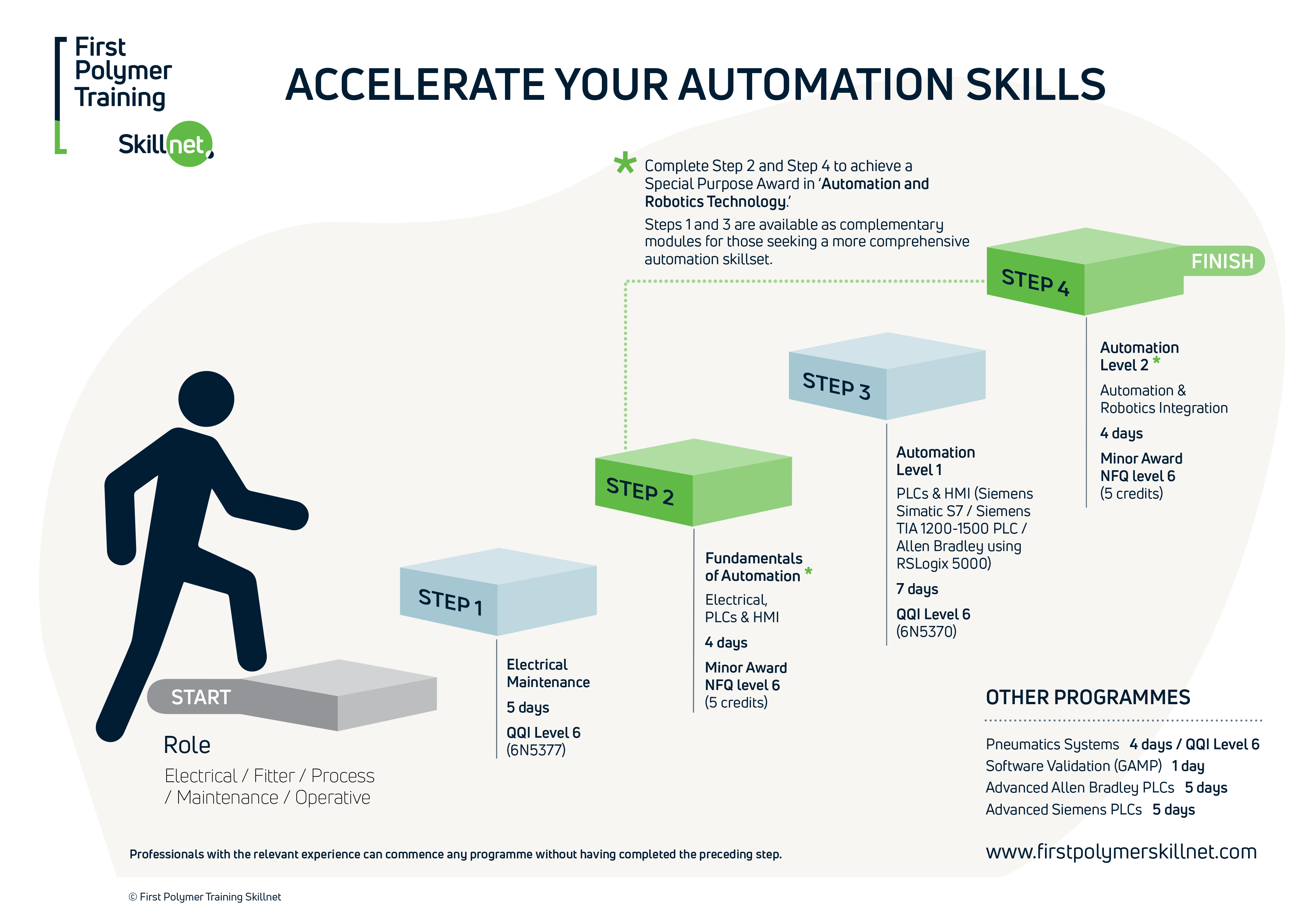
Please see our Automation progression pathway below.
Trainer Profile
Desmond Foley is the founder and MD of Focus Automation. He has worked in the Automation Industry for more than 30 years in many industries including Pharmaceutical, Power Generation, Oil and Gas, Food and Beverage and Medical Supplies. He has been responsible for activities ranging from design, program development, testing and commissioning of PLC control systems, to the management of automation projects as a Senior Projects/Automation Engineer. He has been delivering PLC and automation training for over 20 years and has expertly built state of the art Siemens and Allen Bradley training kits to support learner development and competence.
Qualifications: Des has a BSc in Engineering, Dip in EE and Dip in HR.